Lighting a Soviet-era flat: low ceilings, one ceiling point and small rooms
Most of us in Yerevan live in flats built between the 1950s and the 1980s: solid, well-planned, and lit by one bulb in the middle of each ceiling. The ceilings are low, the rooms are small, and the wiring was never meant to change. None of that stops a flat from being beautifully lit. Here is how we would light one, without an electrician and without pretending the ceiling is higher than it is.
Know your ceiling height
Khrushchyovka flats usually have ceilings around 2.5 m; the later panel blocks about 2.6–2.7 m; the Stalin-era buildings in the centre 3 m or more. Below 2.7 m, a pendant that hangs into the room gets in the way, so the shade needs to be flat and wide or sit tight to the ceiling. Above 3 m, a long drop looks right. Measure before you buy anything.
The one ceiling point
Every room has a single wire in the middle of the ceiling, and the furniture rarely sits under it. Three ways round it, cheapest first: swag the cable across the ceiling on a hook to where you want the light, so the pendant hangs over the table or beside the sofa; replace the central fixture with a wide, flat shade that lights the whole room evenly and let lamps do the rest; or stop using the ceiling point altogether and light the room with two or three plug-in lamps. Our guide to hanging a pendant without wiring shows the hook method step by step.
Pendants for a 2.5 m ceiling
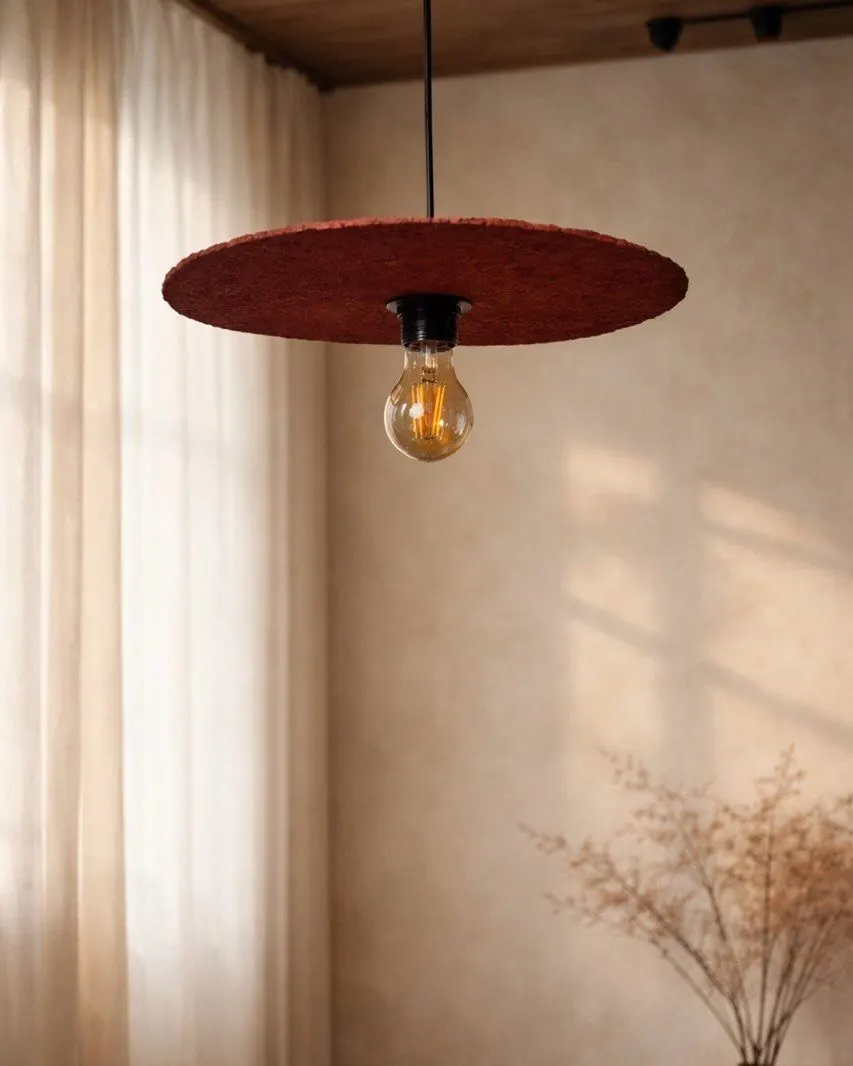
The rule for a low ceiling is wide and shallow. A disc or a flat dome spreads light sideways and leaves headroom; a deep bell or a long cord does not. Keep the bottom of a central shade at least 2.1 m from the floor in a walkway, and over a table it can come down to 70–80 cm above the top, since nobody walks there. A shade that glows, like papier-mache, is better than one that throws a hard beam: with so little height, a bare bulb is always in someone's eyes. The sizing guide has the numbers.
Light the walls, not the floor
Low rooms feel taller when the walls and ceiling are lit, not the carpet. Put a table lamp on a sideboard so it washes the wall behind it, aim a floor lamp upward, and keep the ceiling white or very pale so it bounces light back. A mirror opposite the window doubles the daylight. Dark corners make a small room smaller, so a small lamp in the corner furthest from the window does more than a brighter bulb in the centre.
Warm bulbs, several of them
Soviet flats were built for one 100-watt bulb per room; the modern answer is three or four small warm sources instead. Use LED bulbs at 2700K everywhere in living rooms and bedrooms, 3000K in the kitchen, and keep them all within about 300K of each other so the whites match. Our guide to colour temperature room by room has the full list. Dimmers, or smart bulbs on the plug-in lamps, let one set of lamps work for dinner and for cleaning.
The kitchen and the hallway
The five-square-metre kitchen needs light on the worktop, not in the middle of the floor: a strip under the wall cabinets and one small pendant over the table against the wall. The long dark hallway is where a plug-in pendant or a wall light on a swag hook changes everything, because there is often no ceiling point at all where you need it. Hang it low enough to notice, around 1.8 m, and warm.
Pieces that suit these rooms
Everything below is made by hand in Yerevan, to order; the flat shapes and small table lamps were designed with exactly these flats in mind, and most can be made in another colour or size.
- Disc-Shaped Pendant Lamp — ⌀ 34 cm — 10,000 AMD
- Yellow Pendant Lamp — 26 × 10 cm — 12,000 AMD
- Two-Tone Dome Pendant — 34 × 15 cm — 11,000 AMD
- Cement Table Lamp — 7.5 × 9.5 cm — 9,000 AMD
- Curved Desk Lamp — Made to order — 14,000 AMD
- Cordless Mushroom Table Lamp — 19 × 20 cm — price on request
For a bedside without a socket, the cordless mushroom lamp needs no cable at all, and our bedroom lighting guide covers the rest of the room.
A weekend plan
Saturday: measure the ceiling, decide where the table and sofa really are, buy a plug-in cord set, two hooks and warm 2700K bulbs. Sunday: swag the central cable to where the light should be, hang a flat shade, add a table lamp against the longest wall and one in the darkest corner, change every bulb to the same warm white. The flat will not be taller on Monday, but it will feel it.
Frequently asked questions
What pendant light works with a 2.5 m ceiling?
A wide, shallow shade such as a disc or a flat dome, hung with its bottom edge at least 2.1 m from the floor in walkways, or 70–80 cm above a table. Avoid deep bells and long cords, and choose a shade that glows rather than one that shows the bulb.
How do I move the light if the ceiling point is in the middle of the room?
Swag the cable across the ceiling on a hook to the spot you want, or use a plug-in pendant on a hook and a wall socket. Neither needs an electrician or new wiring.
How do I make a low room feel taller with light?
Light the walls and ceiling rather than the floor: lamps that wash walls, an uplighter, a pale ceiling, a mirror opposite the window, and a small lamp in the darkest corner.
Which bulbs for a Soviet-era flat?
Several small warm LED bulbs instead of one bright one: 2700K in living rooms and bedrooms, 3000K in the kitchen, all within about 300K of each other. Dimmers or smart bulbs help the same lamps work for every evening.
How do I light a five-square-metre kitchen?
Light the worktop, not the floor: an LED strip under the wall cabinets and one small warm pendant over the table against the wall.
Can handmade pendants be made for a low ceiling?
Yes. Our flat and shallow pendants are made to order in Yerevan, and the cord length and shade size can be set for your ceiling height.
Lighting a flat like this?
Tell us the ceiling height and where the table and sofa are, and we will suggest the shape and size that fits.
Message us on Instagram