Japandi bedroom lighting: bedside lamps, low pendants and warm light
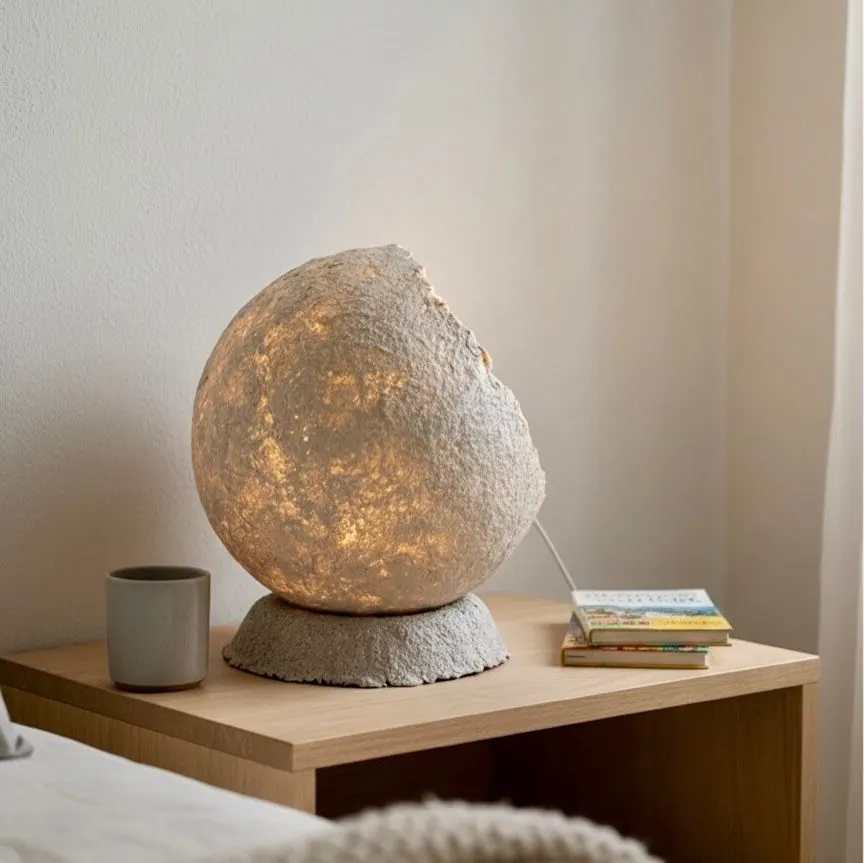
Japandi, the meeting of Japanese restraint and Scandinavian warmth, is mostly a question of what you leave out. In a bedroom that means fewer objects, natural materials and a light that is low, warm and soft. Here is how we would light one, from the number of lamps to the height of a pendant over a nightstand, with pieces from our studio that were made for exactly this kind of room.
Three layers, all of them warm
A bedroom needs very little light, but it needs it in the right places. Think in three layers: a soft general light for moving around, a bedside light for reading, and, if you like, one small accent that glows on a shelf or dresser. Keep every bulb in the same warm white, 2700 K or even 2200 K for a candle-like glow, and put the general light on a dimmer. Cool white light belongs in a kitchen; in a Japandi bedroom it undoes everything else you have done. Our bulb guide explains the numbers.
Skip the ceiling fixture if you can
The single bright ceiling light is the enemy of a calm bedroom. If you have a central ceiling point, hang a large, low pendant in paper or linen so the bulb is hidden and the shade itself glows, and dim it. If you can leave the ceiling dark and light the room from two or three low sources instead, do: light that comes from below eye level makes a room feel quieter and smaller in the good sense. Rooms without a ceiling point do not need an electrician; our guide to hanging a pendant without wiring shows how.
Bedside: lamp or pendant
The classic Japandi bedside is a small table lamp with a rounded shade, in paper, linen or ceramic, at about the height of your shoulder when you sit up in bed: the bottom edge of the shade roughly at eye level, so you see the glow and not the bulb. On a nightstand of 50–60 cm, that means a lamp of about 40–55 cm overall. Mushroom lamps are ideal here because the whole cap glows and the light stays low.
The other answer, and the one that makes a small bedroom feel designed, is a pendant hung low beside the bed instead of a table lamp. It frees the nightstand, and the cord becomes a vertical line on the wall. Hang the bottom of the shade 50–70 cm above the nightstand, or around 140–160 cm from the floor, slightly to the outside of the bed so you do not knock it when you reach for a glass. Two matching pendants either side of the bed is the Japandi version of symmetry. Our pendant sizing guide covers the proportions.
Materials: paper, linen, cement, wood
Japandi lives on texture rather than colour. Paper and papier-mâché give a soft, even glow and a chalky, hand-finished surface. Linen and natural fibres add weave and warmth. Cast cement grounds a lamp and reads as stone. Wood ties them together. Avoid chrome, glass shades and anything glossy: matte surfaces take light quietly. Our guide to raffia, jute and linen lampshades and our wabi-sabi styling guide go deeper into both.
One colour, used once
Keep the palette to off-white, oat, clay and charcoal, and let one lamp carry a single quiet colour: sage green, dusty terracotta, a warm ochre. One coloured shade in an otherwise neutral room becomes the point of the room; two start to compete. If the bedding is already coloured, keep every lamp neutral.
Pieces that suit a Japandi bedroom
Each of these is shaped by hand in Yerevan, made to order and, in most cases, available in another colour or size so it can match the room exactly.
- Glowing Mushroom Lamp — 28 × 30 cm — 10,000 AMD
- White Mushroom Table Lamp — Made to order — 10,000 AMD
- Moon Table Lamp — Made to order — 11,000 AMD
- Linen Pendant Lamp — 18 × 24 cm — 14,000 AMD
- Sage Dome Pendant — Made to order — 9,000 AMD
- Classic Shade Table Lamp — Made to order — 15,000 AMD
For a bedside with no socket nearby, the Cordless Mushroom Table Lamp in our mushroom lamp guide is rechargeable and needs no cord at all.
A few practical rules
- Put the general light and, if possible, the pendants on a dimmer or a smart bulb, and leave bedside lamps on their own switches within reach of the bed.
- Choose bulbs within the fitting's maximum wattage, and LED only for paper and fabric shades.
- Keep lamps away from the window if it is left open in rain, and paper shades away from humidifiers.
- Dust paper and fibre shades with a soft dry brush; wipe cement with a dry cloth. The care guide has the rest.
Frequently asked questions
What lighting suits a Japandi bedroom?
Low, warm and soft: a dimmable general light or a large paper or linen pendant, a small rounded bedside lamp or a low pendant either side of the bed, and at most one small accent light. Keep every bulb at 2700 K or warmer and the materials matte and natural.
How high should a bedside pendant hang?
With the bottom of the shade about 50–70 cm above the nightstand, or roughly 140–160 cm from the floor, slightly to the outside of the bed so it is not knocked. Two matching pendants either side of the bed look balanced.
How tall should a Japandi bedside lamp be?
About 40–55 cm overall on a nightstand of 50–60 cm, so the bottom edge of the shade sits near eye level when you are sitting up in bed and you see the glow rather than the bulb.
Which bulb colour is best for a bedroom?
Warm white, 2700 K, or 2200 K for a candle-like glow, on a dimmer where possible. Cool white light makes a bedroom feel clinical.
Can I have a pendant beside the bed without an electrician?
Yes. A plug-in cord set with a ceiling hook lets you hang a pendant from any ceiling and plug it into a wall socket; our guide to hanging a pendant without wiring explains how.
Do you make lamps in a specific colour for a bedroom?
Yes. Each piece is made to order in Yerevan, and most can be made in another colour or size to match the room. Message us with the colours of the bedding and walls.
Lighting a bedroom?
Send us a photo of the room and the colours you have in mind, and we will suggest a lamp or pendant and make it to match.
Message us on Instagram